The New York Times has just posted to its website a secret, 617-page report prepared by the Justice Department on how the U.S. government helped former Nazis, and then prosecuted many who had come to the U.S. under false pretenses. The Justice Department ordered that the report be made, but then suppressed it for four years. Someone just gave the Times the full report, which is available at: Secret Justice Department Report Details How the U.S. Helped Former Nazis.
There is an appendix to the report that gives information about 143 Nazi persecutors whom the Office of Special Investigations, formed in 1979 to investigate and deport Nazi war criminals, prosecuted and attempted to deport (in many cases succeeding).
I have extracted the reports on those accused of committing atrocities in Latvia and Estonia, and they are copied here.
Bogdanovs, Boleslavs
Born: 1917, Russia
Died: 1984, US
Alleged Persecutory Activity: Member of the "Arajs Kommando," a Latvian death squad responsible for mass execution of thousands of civilians in Nazi-occupied Latvia. The victims of the mass shootings were mostly Jewish, but also included political enemies (those believed to be Communists), gypsies and the mentally ill. The leader of the organization, Viktor Arajs, was convicted in West Germany for leading the unit in murdering more than 13,000 people.
Legal history: Denaturalization proceedings commenced in Nov. 1983. Bogdanovs died before the case was resolved.
Detlavs, Karlis
Born: 1911, Latvia
Died: 1983, US
Alleged Persecutory Activity: As a member of the Latvian Auxiliary Security Police, he executed Jews in the Riga ghetto and chose Jews for execution in the Dwinsk ghetto.
Legal History: Detlavs never became a U.S. citizen. INS filed a deportation action in 1976. An immigration judge rejected the government’s case in 1980 and that decision was affirmed on appeal the following year.
Didrichsons, Valdis
Born: 1913, Latvia
Died: 1995, U.S. A
lleged Persecutory Activity: Member of the Arajs Kommando (see Bogdanovs).
Legal History: The government filed a denaturalization suit in May 1988. The case settled in Feb. 1990 with Didrichsons agreeing to relinquish his citizenship. Because he was ill, the U.S. agreed not to institute deportation proceedings.
Hazners, Vilis
Born: 1905, Latvia
Died: 1989, U.S.
Alleged Persecutory Activity: Selected Latvian Jews in the Dwinsk ghetto for execution.
Legal History: Hazners never became a U.S. citizen. A denaturalization action was filed by INS in Jan. 1977. The government’s claims were rejected in 1980 and OSI handled the appeal. The immigration judge’s decision was affirmed in 1981.
Inde, Edgars
Born: 1909, Latvia
Died: 1980, U.S.
Alleged Persecutory Activity: Member of the Arajs Kommando (see Bogdanovs)
Legal History: The government filed a denaturalization suit in Aug. 1988. Inde died before the court issued a ruling. [RL: There’s obviously an error in dates here].
Kalejs, Konrads.
Born: 1913, Latvia
Died: 2001, Australia
Alleged Persecutory Activity: Officer in the Arajs Kommando (see Bogdanovs) and a guard supervisor at the Salaspils concentration camp near Riga, Latvia.
Legal History: Kalejs never became a U.S. citizen. A deportation action was filed in Nov. 1984 and he was ordered deported to Australia in Nov. 1988. His appeals were exhausted in Mar. 1994 and he was deported the following month. See pp. 469-478,493.
Kaklins, Talivaldis
Born: 1914, Latvia
Died: 1983, U.S.
Alleged Persecutory Activity: Member of Latvian District Police and director of the Madona concentration camp in Latvia. As a member of the District Police, he participated in two mass executions of hundreds of Jews and Soviet activists.
Legal History: A denaturalization case was filed in 1981. It was pending when he died.
Kauls, Juris
Born: 1912, Latvia
Alleged Persecutory Activity: Deputy chief and COn1I11anJer of the guards at a Nazi concentration camp near Riga, Latvia
Legal History: A denaturalization case was filed in 1984. Kauls left for Germany in 1988 while the case was still pending. The court entered a default judgment of denaturalization.
Kirsteins,Mikelis
Born: 1916, Russia
Died: 1994, U.S.
Alleged Persecutory Activity: Member of the Arajs Kommando (see Bogdanovs)
Legal History: A denaturalization case was filed in July 1987. The case settled in Dec. 1991, with Kirsteins relinquishing his citizenship and the U.S. agreeing not to file a deportation action unless the defendant's medical condition improved.
Laipenieks, Edgars
Born: 1913, Latvia
Died: 1998, U.S.
Alleged Persecutory Activity: Member of the Latvian Political Police which pursued Jews and Communists.
Legal History: Laipenieks never became a U.S. citizen. A deportation case was filed in June 1981. The government lost; the decision was reversed on appeal, and then reversed again. See pp. 117-126.
Linnas, Karl
Born: 1919, Estonia
Died: 1987, U.S.S.R.
Alleged Persecutory Activity: Chief of concentration camp in Tartu, Estonia
Legal History: Denaturalization proceedings commenced in Nov. 1979. Linnas' citizenship was revoked in June 1981 and his appeals were exhausted in Oct. 1982. A deportation action was filed in June 1982 and Linnas was ordered deported in May 1983. Appeals were exhausted in Apr. 1987 at which time he was deported to the U.S.S.R. See pp. 273-297.
Maikovskis, Boleslavs*
Born: 1904, Latvia
Died: 1996, Germany
Alleged Persecutory Activity: Latvian chief of police who participated in the arrest of civilians and the burning of their dwellings.
Legal History: Maikovskis never became a U.S. citizen. INS filed a deportation case in Oct. 1976. Maikovskis was ordered deported to Switzerland in Aug. 1984. Switzerland would not allow him entry and OSI asked the court to modify its order to designate the U.S.S.R. In Oct. 1987, while that request was pending, Maikovskis left for West Germany. In 1988, Germany charged him with war crimes. His trial was suspended due to the defendant's ill health. See pp. 430, 433-434.
Sprogis, Elmars
Born: 1914, Latvia
Died: 1991, U.S.
Alleged Persecutory Activity: Assistant Chief of Police in Gulbene, Latvia. He was involved in the arrest, transportation, and confiscation of property from nine Jews, the transportation of 100 to 150 Jews to the site of their execution, and the appropriation of furniture from the houses of arested Jews. Legal History: A denaturalization complaint was filed in June 1982. The government lost the case both in the district court and on appeal. See pp. 101-105.
Trucis, Arnolds
Born: 1909, Latvia
Died: 1981, U.S.
Alleged persecutory activity: Member of the Latvian Auxiliary Police and the Security Service of the SS which guarded and beat Jewish civilians.
Legal History: A denaturalization action was filed in June 1980. Trucis died before the matter was resolved.
Showing posts with label Holocaust. Show all posts
Showing posts with label Holocaust. Show all posts
Saturday, November 13, 2010

Saturday, October 30, 2010
Yad Vashem - Untold Stories of the Murder Sites in the Occupied USSR
I just came across a New York Times article published last year about new research being done at Yad Vashem on lesser-known killing fields in the Holocaust: "New Looks at the Fields of Death for Jews" (April 19, 2009). One report about Liepaja is from a German sailor who filmed the killings at Skede.
One little-known case comes from a German sailor who filmed killings in Liepaja, Latvia. The film has been on view for some years at the Yad Vashem museum. But the new Web site has a forgotten video of a 1981 interview with the sailor, Reinhard Wiener, who said he had been a bystander with a movie camera.
According to part of his account, “After the civilian guards with the yellow armbands shouted once again, I was able to identify them as Latvian home guardsmen. The Jews, whom I was able to recognize by now, were forced to jump over the sides of the truck onto the ground. Among them were crippled and weak people, who were caught by the others.Yad Vashem has created a website devoted to this topic - the Untold Stories. There are several pages devoted to what happened in Liepaja.
“At first, they had to line up in a row, before they were chased toward the trench. This was done by SS and Latvian home guardsmen. Then the Jews were forced to jump into the trench and to run along inside it until the end. They had to stand with their back to the firing squad. At that time, the moment they saw the trench, they probably knew what would happen to them. They must have felt it, because underneath there was already a layer of corpses, over which was spread a thin layer of sand.
Friday, September 3, 2010
Sima Schlossberg and her family in Jelgava
I just found another resource to research the Jews of Latvia - the Latvian Names Project. It is an attempt to do for all of the Jews of Latvia what Edward Anders and his co-workers were able to do for Liepaja - identify the fates of Jews who lived in Latvia before the Second World War. In 1935 the Latvian census recorded 93,479 Jews living in Latvia.
I looked up the name of my relative from Jelgava, Latvia - Sima Schlossberg. She came up on the list, and so did the names of her family - names that she doesn't refer to in her letters to my grandfather. Her sister's name was Miriam, and she was born on August 5, 1909. Sima herself was born on November 27, 1911. Their parents' names were Itzik Ruben and Esther Raschel. Only the possible fate of Miriam Schlossberg is mentioned - in the Riga Ghetto.
Looking back in correspondence from March and April of 2004 (with Miriam's daughter and with a cousin of Sima's), I discover, however, that I do know the fates of the people in the family. Sima escaped from Riga in 1941 with her parents first to Russia and then to Uzbekistan. Her sister Miriam was already living there because she had fled earlier. Sima's father Itzik died in 1942 from hunger. The two sisters and their mother survived the war. In 1942, Miriam married a man named Mikhail Golod, and her daughter was born in 1943 in Bukhara. They returned to Riga in 1945. Sima worked as a bookkeeper, and in 1955 was married to a man named Nohum Bruk and moved with him to St. Petersburg. She died there in 1988, leaving no children behind. Miriam died in 1980 and her mother Esther Raschel died in 1984 at the age of 100.
I'm going to have to write to the Latvian Names Project and give them information on all of these people.
I looked up the name of my relative from Jelgava, Latvia - Sima Schlossberg. She came up on the list, and so did the names of her family - names that she doesn't refer to in her letters to my grandfather. Her sister's name was Miriam, and she was born on August 5, 1909. Sima herself was born on November 27, 1911. Their parents' names were Itzik Ruben and Esther Raschel. Only the possible fate of Miriam Schlossberg is mentioned - in the Riga Ghetto.
Looking back in correspondence from March and April of 2004 (with Miriam's daughter and with a cousin of Sima's), I discover, however, that I do know the fates of the people in the family. Sima escaped from Riga in 1941 with her parents first to Russia and then to Uzbekistan. Her sister Miriam was already living there because she had fled earlier. Sima's father Itzik died in 1942 from hunger. The two sisters and their mother survived the war. In 1942, Miriam married a man named Mikhail Golod, and her daughter was born in 1943 in Bukhara. They returned to Riga in 1945. Sima worked as a bookkeeper, and in 1955 was married to a man named Nohum Bruk and moved with him to St. Petersburg. She died there in 1988, leaving no children behind. Miriam died in 1980 and her mother Esther Raschel died in 1984 at the age of 100.
I'm going to have to write to the Latvian Names Project and give them information on all of these people.
Websites on journeys to Liepaja
A number of other people have made a similar journey to Liepaja to see where their ancestors lived. I just found a website created by Arturo and Marc Porzecanski about their visit to Liepaja (among other places in eastern Europe) in 2002: Our trip. The direct link to the page on Liepaja is: Our Trip to Liepaja.
Brian Friedman created the Welcome to Avaslan website about his family in eastern Europe, including Liepaja. Like me and the Porzecanskis, he found the house where his relatives in Liepaja had lived. He also has a page on the Killing Fields of Skede and photographs of the memorials there.
Brian Friedman created the Welcome to Avaslan website about his family in eastern Europe, including Liepaja. Like me and the Porzecanskis, he found the house where his relatives in Liepaja had lived. He also has a page on the Killing Fields of Skede and photographs of the memorials there.
Sunday, August 1, 2010
Touring Copenhagen - Resistance Museum

I arrived in Copenhagen Friday afternoon from Tartu, via Riga (which was a little nerve-wracking, because I had left one piece of luggage in the luggage storage room in the airport, and I had to figure out how to get it on as hand luggage without paying an enormous sum of money to Air Baltic, which allows only one piece of checked luggage - but I did get it on without having to pay). I was pretty tired, so I didn't go anywhere once I got here, but I went out yesterday morning. The first challenge was figuring out how to buy a metro ticket at the closest stop - there were directions in English, but they weren't very clear. With the help of several patient Danish people, I bought the ticket and headed for my first destination, the harbor, where I was going to take a harbor tour.
It was really a beautiful day - not too hot, with a nice breeze, and it was great to be out on the water. We sailed into the harbor and on several canals (I hadn't realized before this that Copenhagen has canals), passing lots of other tourist boats doing the same thing.
 |
| People relaxing at the water's edge, with the Amalieborg castles behind them. |
The museum was divided into several sections, starting with a general introduction to Nazism. While some of the exhibits were photographs or facsimiles, many were authentic artifacts of the time period. One of the first items that I saw, to my shock, was the label below from a canister of Zyklon B, which had been found by a Dane in the hold of a sunken German ship.

The next part of the museum was devoted to the first stage of the Nazi occupation of Denmark – accommodation to the wishes of the occupiers. Germany occupied Denmark on April 9, 1940, and the Danish government quickly capitulated. The Germans ruled Denmark through a Danish government coalition, so that full Nazi policies were not implemented (for example anti-Jewish legislation). This included Denmark furnishing Germany with many of its food needs during the war, as well as favorable trade agreements for Germany. The next item illustrates this trade.


The Communist Party was not outlawed in Denmark until the Nazi invasion of the Soviet Union in June 1941. At that point, the Germans told the Danish government to intern the leaders of the Danish communists, which they did. In November 1942 about 250 were sent to the Horseroed camp, which was run by the Danish police, not by the Nazi Gestapo (later on it was taken over by the Nazis).
 |
| A drawing from the internment camp by one of the inmates, Knudaage Larsen. |

The Danish resistance was in close communication with the British by various methods, including illegal telegraph machines. The picture below shows a reconstruction of a room with equipment used by a telegraphist.

The Jews of Denmark were untouched by German persecution until the Danish government resigned in the summer of 1943, in the face of German decrees that they could not accept. This meant that Denmark was now under direct German rule, and they quickly organized for the arrest of the entire Danish Jewish community on October 1-2 (Rosh Hashanah). The Danish underground found out about the German decree, and through quick action, managed to save almost the entire community by ferrying them to Sweden.

About 500 Jews, however, did not manage to get away – they were captured and sent to Terezin. Most of them survived the war without being deported to Auschwitz because of pressure exerted by the Danish government and aid sent by the Danish Red Cross.
(I visited Terezin in the summer of 2005 when I visited Prague - I wrote about it here).

This is a revolting German propaganda poster [from 1942] about Jews being forced to wear the yellow star. The text reads:
The cat cannot change his spots!
The leading English newspaper "Daily Mail" reported:
"The participation of Jews in breaking British wartime economic legislation has caused Judaism and Jewish names to be ostracized in England, said the Chief Rabbi Dr. J. Hertz in a London synagogue."
With these accusations, the rabbi certainly wanted to warn his racial comrades to greater caution in their dark black marketing business, so that the English people would not recognize whose lice are in the fur. His efforts, however, are likely to be in vain. So are the Jews. First they chase the people into war, and while the soldiers of those nations fight and bleed, they make business out of the war, pushing and cheating and filling their filthy pockets at the expense of their host peoples. In Germany the blame was pinned on them. We have separated them from the German national community and they are marked with a yellow Star of David.
Everyone knows: Whoever wears this sign is an enemy of our people.

When I came out of the museum I was feeling sad at the fate of some of the resistance fighters (who were captured and executed by the Nazis), and sat for a little while thinking and looking out over a stream. I then walked towards what turned out to be a fort, but on the way encountered a statue erected after the war, dedicated to those who had fallen in the war. (It's below).
 |
| Our fallen in Danish and allied war service 1940-1945 Raised by the Danish people |
Wednesday, July 28, 2010
Libau and Skede - remembrances of the past
As promised, here is my report on my day in Liepaja. After this, I'll write up my visit to Tartu, Estonia, at the international Society of Biblical Literature conference, which is wrapping up tomorrow. On Friday, I'm flying to Copenhagen for two days, which I intend to spend going to museums and enjoying myself, and then on Monday, I'm going back to Ithaca, at long last.
My visit to Liepaja occurred largely because Ieva Gundare, my guide, urged me to do it after I had written her about my family in Liepaja. I’m very grateful that she hired the driver and the other guide (in Liepaja), came to Liepaja with me, and translated what Sandra, the other guide, said in Latvian. Ieva also generously made sandwiches and brought fruit to eat for all of us.
The day began when she came to my hotel in Riga, and we drove to Liepaja, about a two hour drive from Riga. About a half an hour before we arrived in Liepaja, we passed by a large wind farm – many wind turbines turning in the wind.

From Liepaja, July 22, 2010
When we came into Liepaja, we went to a hotel in the center of the city and met the local guide, Sandra. The first place we drove to was the Skede dunes, about fifteen miles/kilometers north of the city along the Baltic sea. This is the place where the Nazis killed thousands of people, Jews, Latvians, and Soviet prisoners of war. It is likely where Dobra Falkon, the wife of Mottel-Mordchai Falkon, my great-great uncle, was killed with thousands of other Jews in mid-December 1941.
There are two memorials at Skede – one set up by the Soviets, which says that 19,000 people were killed there (it does not mention Jews specifically at all), and another recently built by the local Liepaja Jewish community, with support from the Latvian government and groups in Latvia, Israel, and the U.S. This memorial repeats the assertion that 19,000 people were killed at Skede, but this figure is incorrect – it’s much too large. Edward Anders and Vladimir Bans erected a plaque nearby (in Russian, Latvian, and English) that more accurately states who was killed at Skede.
Anders and Bans put up this plaque because the other one only mentions Jewish victims of the Nazi murderers, at the insistence of the local Jewish organizers of the memorial. Anders and Bans felt that it was important to honor and remember all who were killed there, Jews and non-Jews. Anders wrote, “We and many fellow Liepaja Jews do not understand the mentality of people who refuse to honor non-Jewish victims—including rescuers of Jews and Soviet POWs—who opposed the Nazis and were killed by them.” I cannot help but think that this division, and the refusal to acknowledge the suffering and deaths of those who together with Jews opposed the Nazis, is another sign of the persistence of the hatred that the Nazis sowed in this part of the world.
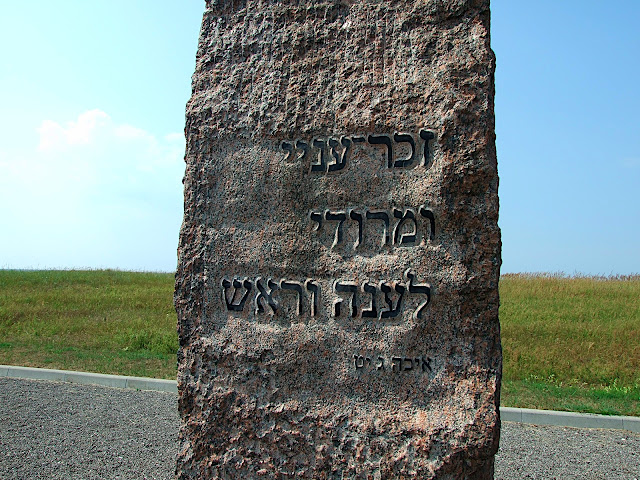
The memorial at Skede is built in the shape of a giant menorah. At the entrance there are two big triangular plaques, one with a biblical verse on it, the other acknowledging all those who made the memorial possible. At the end of each branch of the menorah, next to the dunes, is a stone with another verse engraved on it (seven in all). The following two photographs are of the introductory plaques.
The biblical verse is from the book of Lamentations 1:12 – “May it not come upon you, all who pass on the way; look and see if there is any pain like my pain which is done to me!”
The next pictures are of the dunes and the sea. It is a lonely spot. The last sight for those who were killed here was of the sea.
The next place we went to was inside Liepaja, at another location where Jews were murdered during July 1941 – near a lighthouse that is currently inside an army camp. There is a memorial plaque on a wall outside in Latvian and Russian, underneath an older Soviet memorial that doesn’t mention Jews. I’ve tried to translate the Latvian via Google translate, so it’s not exact:
It’s possible that my great-great uncle, Mottel-Morchai Falkon, was killed here in July 1941. The list of victims of the Nazis in Liepeja that Edward Anders and his colleagues have drawn up from many sources lists his death as occurring in July. The killings began almost as soon as the Germans entered Liepaja, on June 29. The first killings at the lighthouse occurred on July 7.
We next drove to the Jewish cemetery in Liepaja, which is still largely intact. Ieva said that this was the largest still existing Jewish cemetery in Latvia – when she saw it for the first time she was very surprised by its size. The graves and tombstones there are for people who died up until 1941. The first victims of the Nazis were buried in a mass grave at the cemetery (I did not see this), but afterwards they were buried where they were killed.
In the late 1990s Edward Anders and his colleagues began to work on assembling the names of Liepaja Jews who were living in the city before 1940, and discovering their fates under the Soviet and Nazi occupations. They came up with a list of more than 7,000 Jews who had died at the hands of the Nazis or the Soviets. (The Soviets invaded Latvia on June 17, 1940, and on June 14, 1941, they deported thousands of people from the three Baltic states of Latvia, Lithuania and Estonia to the Gulag camps or to Siberia; 208 of these were Jews from Liepaja. The Nazis invaded the Soviet Union on June 22, 1941 – this included the three Baltic states, which were among the first locations to be overrun by the German armies. The first German killing squad arrived in Liepaja on June 29, 1941 – from Einsatzgruppe A. The Einsatzgruppen followed close behind the German armies invading the Soviet Union, and were responsible for killing about one million Jews).
In 2004 a memorial wall to the murdered Liepaja Jews was erected in the Jewish cemetery, listing the names of all the Jewish victims, those brave people who rescued Jews (33 Jews survived in Liepaja itself because they were protected by non-Jews), and the names of the donors. The wall was renewed in a more durable form in 2008.
The section of the wall with the names of my relatives, listing their names and ages at death, is on the next page: three generations of the family. Dobra and Mottel-Mordchai were in their early 70s, their son Abram was 47, and his two children Betja and Genia were 18 and 19 years old.
We then walked around the cemetery for about a half an hour, looking at the headstones of people who had been buried there. I took some photos of the headstones, which I will post later on my blog. I’ve copied the Hebrew and translated it – some of the epitaphs are quite moving, indicating the love that the family had for the person who died. The memorial to the Jews who died in the Holocaust is the only demonstration of their descendants and relatives that they are also fondly remembered.
Our next and last stop was the part of Liepaja where the Nazis established a ghetto. 832 Jews who remained alive in Liepaja on July 1, 1942 were forced into a ghetto of one block. One of the streets bounding the ghetto was Barenu iela [street] – and my great-great uncle Mottel-Mordchai lived at 19 Barenu iela. It turned out that his house was not included in the ghetto area, but it was not very far away. We drove Barenu iela and past the ghetto area. It seemed that most of the houses there had probably been there in the 1940s – they were old wooden houses, not the new housing built by the Soviets in the newer parts of the city.
When we came to the probable location of his house, there was nothing there – only the foundation and some of the wooden floor. According to Sandra, the house had been standing up until three years before, and then was torn down because it was in such bad shape. I have photographs of the house foundation and other houses on the street.
Notice the apartment building behind the foundations – it’s from the Soviet period.
The next few buildings are from Barenu iela.
16 Barenu iela.
20 Barenu iela.
16 Barenu iela.
It was strange to stand on the same street I know that my relatives lived on, so many years ago. If they had survived the Nazi extermination, maybe there would still be members of the family living in this house, or in the city of Liepaja.
I never thought I would ever visit Liepaja - I was afraid of how I would feel, that it would simply be too emotionally overwhelming to be there. What I found, however, was that although I felt emotional at times - sadness, especially at the Skede beach, and anger at the Nazis for their vicious crimes, especially when I was at the Rumbula massacre site in Riga - the passage of time made the events of that time seem simply too far away. I think I also had the idea, somehow, that going to the place where these events happened, where the Nazis had committed their murders, would enable me to understand them better.
But instead I had the same feeling that I had in the fall of 2001 when I went to the site of the World Trade Center after the terrorist attacks - blank incomprehension. On the emotional level, I simply still do not understand how people could do these things, how they could kill innocent people in the street, how they could round them up and kill them in a public park, how they could assemble them together and drive them in trucks to the beach and shoot them at the edge of a enormous pit.
Why did the murderers not become revolted by what they were doing and simply stop? I've read theories of how soldiers can become indoctrinated to believe there is nothing wrong with killing other people in war, and that this brutalization can then be exploited so that they are willing to kill civilians (Christopher Browning has written about this). But when I picture a soldier faced with a woman or child, somebody who is clearly not a combatant, it is very hard for me to understand how he could imagine that it is permitted to kill them. Wouldn't he think of his own family - his mother or sister, or wife, or his own children?
I obviously do not have the answers to these questions. Maybe there are others who do, but I am still left with the blank incomprehension.
My visit to Liepaja occurred largely because Ieva Gundare, my guide, urged me to do it after I had written her about my family in Liepaja. I’m very grateful that she hired the driver and the other guide (in Liepaja), came to Liepaja with me, and translated what Sandra, the other guide, said in Latvian. Ieva also generously made sandwiches and brought fruit to eat for all of us.
The day began when she came to my hotel in Riga, and we drove to Liepaja, about a two hour drive from Riga. About a half an hour before we arrived in Liepaja, we passed by a large wind farm – many wind turbines turning in the wind.
From Liepaja, July 22, 2010
When we came into Liepaja, we went to a hotel in the center of the city and met the local guide, Sandra. The first place we drove to was the Skede dunes, about fifteen miles/kilometers north of the city along the Baltic sea. This is the place where the Nazis killed thousands of people, Jews, Latvians, and Soviet prisoners of war. It is likely where Dobra Falkon, the wife of Mottel-Mordchai Falkon, my great-great uncle, was killed with thousands of other Jews in mid-December 1941.
There are two memorials at Skede – one set up by the Soviets, which says that 19,000 people were killed there (it does not mention Jews specifically at all), and another recently built by the local Liepaja Jewish community, with support from the Latvian government and groups in Latvia, Israel, and the U.S. This memorial repeats the assertion that 19,000 people were killed at Skede, but this figure is incorrect – it’s much too large. Edward Anders and Vladimir Bans erected a plaque nearby (in Russian, Latvian, and English) that more accurately states who was killed at Skede.
| ||
| From Liepaja, July 22, 2010 |
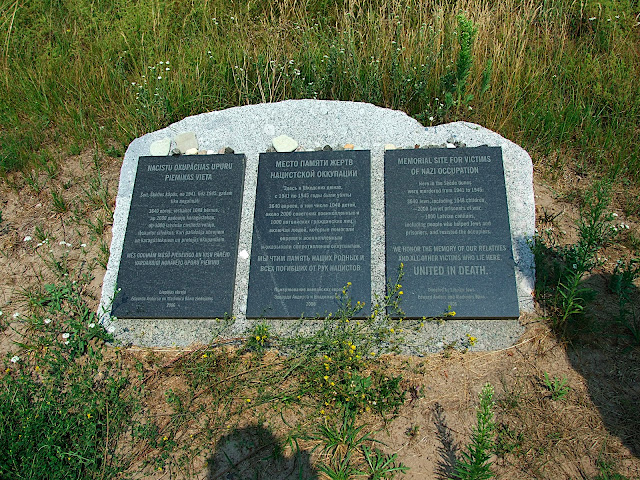
Anders and Bans put up this plaque because the other one only mentions Jewish victims of the Nazi murderers, at the insistence of the local Jewish organizers of the memorial. Anders and Bans felt that it was important to honor and remember all who were killed there, Jews and non-Jews. Anders wrote, “We and many fellow Liepaja Jews do not understand the mentality of people who refuse to honor non-Jewish victims—including rescuers of Jews and Soviet POWs—who opposed the Nazis and were killed by them.” I cannot help but think that this division, and the refusal to acknowledge the suffering and deaths of those who together with Jews opposed the Nazis, is another sign of the persistence of the hatred that the Nazis sowed in this part of the world.
The memorial at Skede is built in the shape of a giant menorah. At the entrance there are two big triangular plaques, one with a biblical verse on it, the other acknowledging all those who made the memorial possible. At the end of each branch of the menorah, next to the dunes, is a stone with another verse engraved on it (seven in all). The following two photographs are of the introductory plaques.
 |
| From Liepaja, July 22, 2010 |
 |
| From Liepaja, July 22, 2010 |
The biblical verse is from the book of Lamentations 1:12 – “May it not come upon you, all who pass on the way; look and see if there is any pain like my pain which is done to me!”
The next pictures are of the dunes and the sea. It is a lonely spot. The last sight for those who were killed here was of the sea.
 |
| From Liepaja, July 22, 2010 |
 |
| From Liepaja, July 22, 2010 |
| ||
| From Liepaja, July 22, 2010 |
The next place we went to was inside Liepaja, at another location where Jews were murdered during July 1941 – near a lighthouse that is currently inside an army camp. There is a memorial plaque on a wall outside in Latvian and Russian, underneath an older Soviet memorial that doesn’t mention Jews. I’ve tried to translate the Latvian via Google translate, so it’s not exact:
Stop people! [addressed to passersby]
At this place on July 27, 1941 in Liepaja
fascist murders took place during the Jewish Holocaust
It’s possible that my great-great uncle, Mottel-Morchai Falkon, was killed here in July 1941. The list of victims of the Nazis in Liepeja that Edward Anders and his colleagues have drawn up from many sources lists his death as occurring in July. The killings began almost as soon as the Germans entered Liepaja, on June 29. The first killings at the lighthouse occurred on July 7.
 |
| From Liepaja, July 22, 2010 |
 |
| From Liepaja, July 22, 2010 |
We next drove to the Jewish cemetery in Liepaja, which is still largely intact. Ieva said that this was the largest still existing Jewish cemetery in Latvia – when she saw it for the first time she was very surprised by its size. The graves and tombstones there are for people who died up until 1941. The first victims of the Nazis were buried in a mass grave at the cemetery (I did not see this), but afterwards they were buried where they were killed.
In the late 1990s Edward Anders and his colleagues began to work on assembling the names of Liepaja Jews who were living in the city before 1940, and discovering their fates under the Soviet and Nazi occupations. They came up with a list of more than 7,000 Jews who had died at the hands of the Nazis or the Soviets. (The Soviets invaded Latvia on June 17, 1940, and on June 14, 1941, they deported thousands of people from the three Baltic states of Latvia, Lithuania and Estonia to the Gulag camps or to Siberia; 208 of these were Jews from Liepaja. The Nazis invaded the Soviet Union on June 22, 1941 – this included the three Baltic states, which were among the first locations to be overrun by the German armies. The first German killing squad arrived in Liepaja on June 29, 1941 – from Einsatzgruppe A. The Einsatzgruppen followed close behind the German armies invading the Soviet Union, and were responsible for killing about one million Jews).
In 2004 a memorial wall to the murdered Liepaja Jews was erected in the Jewish cemetery, listing the names of all the Jewish victims, those brave people who rescued Jews (33 Jews survived in Liepaja itself because they were protected by non-Jews), and the names of the donors. The wall was renewed in a more durable form in 2008.
The section of the wall with the names of my relatives, listing their names and ages at death, is on the next page: three generations of the family. Dobra and Mottel-Mordchai were in their early 70s, their son Abram was 47, and his two children Betja and Genia were 18 and 19 years old.
 |
| From Liepaja, July 22, 2010 |
| ||
| From Liepaja, July 22, 2010 |

| ||
| From Liepaja, July 22, 2010 |

| ||
| From Liepaja, July 22, 2010 |

We then walked around the cemetery for about a half an hour, looking at the headstones of people who had been buried there. I took some photos of the headstones, which I will post later on my blog. I’ve copied the Hebrew and translated it – some of the epitaphs are quite moving, indicating the love that the family had for the person who died. The memorial to the Jews who died in the Holocaust is the only demonstration of their descendants and relatives that they are also fondly remembered.
Our next and last stop was the part of Liepaja where the Nazis established a ghetto. 832 Jews who remained alive in Liepaja on July 1, 1942 were forced into a ghetto of one block. One of the streets bounding the ghetto was Barenu iela [street] – and my great-great uncle Mottel-Mordchai lived at 19 Barenu iela. It turned out that his house was not included in the ghetto area, but it was not very far away. We drove Barenu iela and past the ghetto area. It seemed that most of the houses there had probably been there in the 1940s – they were old wooden houses, not the new housing built by the Soviets in the newer parts of the city.
When we came to the probable location of his house, there was nothing there – only the foundation and some of the wooden floor. According to Sandra, the house had been standing up until three years before, and then was torn down because it was in such bad shape. I have photographs of the house foundation and other houses on the street.
 |
| From Liepaja, July 22, 2010 |
Notice the apartment building behind the foundations – it’s from the Soviet period.
The next few buildings are from Barenu iela.
 |
| From Liepaja, July 22, 2010 |
16 Barenu iela.
 |
| From Liepaja, July 22, 2010 |
 |
| From Liepaja, July 22, 2010 |
20 Barenu iela.
 |
| From Liepaja, July 22, 2010 |
16 Barenu iela.
|
| From Liepaja, July 22, 2010 |
It was strange to stand on the same street I know that my relatives lived on, so many years ago. If they had survived the Nazi extermination, maybe there would still be members of the family living in this house, or in the city of Liepaja.
I never thought I would ever visit Liepaja - I was afraid of how I would feel, that it would simply be too emotionally overwhelming to be there. What I found, however, was that although I felt emotional at times - sadness, especially at the Skede beach, and anger at the Nazis for their vicious crimes, especially when I was at the Rumbula massacre site in Riga - the passage of time made the events of that time seem simply too far away. I think I also had the idea, somehow, that going to the place where these events happened, where the Nazis had committed their murders, would enable me to understand them better.
But instead I had the same feeling that I had in the fall of 2001 when I went to the site of the World Trade Center after the terrorist attacks - blank incomprehension. On the emotional level, I simply still do not understand how people could do these things, how they could kill innocent people in the street, how they could round them up and kill them in a public park, how they could assemble them together and drive them in trucks to the beach and shoot them at the edge of a enormous pit.
Why did the murderers not become revolted by what they were doing and simply stop? I've read theories of how soldiers can become indoctrinated to believe there is nothing wrong with killing other people in war, and that this brutalization can then be exploited so that they are willing to kill civilians (Christopher Browning has written about this). But when I picture a soldier faced with a woman or child, somebody who is clearly not a combatant, it is very hard for me to understand how he could imagine that it is permitted to kill them. Wouldn't he think of his own family - his mother or sister, or wife, or his own children?
I obviously do not have the answers to these questions. Maybe there are others who do, but I am still left with the blank incomprehension.
Friday, July 23, 2010
A Day in Riga - the Jews of Riga in the Holocaust
I have just arrived (yesterday) in Tartu, Estonia, for a conference that begins on Sunday. I was in Israel from June 15 to July 21, and then on the morning of the 21st flew to Riga, Latvia, for what an Israeli friend called a מסע לשרשים – a “roots trip.” Some of my family ended up in Latvia – my grandfather’s uncle, Mordechai Falkon, and his wife and family lived in Liepaja (the German name for the city is Libau), a city on the Baltic Sea about a two hour drive from Riga. I don’t know when he moved there or got married – his father was named Bentsel Falkon, from Ukmerge, Lithuania. Mordechai had a brother and sister. His brother, Jacob Morris Falkon, moved to the United States in the 1890s, married, and was the father of my grandfather, Mark Falcon (Lesses). His sister, Gittel, ended up in the Soviet Union, first in Baku, then in Moscow.
I hired a guide to take me around Riga (on Wednesday) and to Liepaja (on Thursday), and also a car with driver and then a second guide in Liepaja (who did not speak English, so the first guide translated what she said). I found the guide through a man named Dr. Edward Anders, who grew up in Liepaja and was saved because he posed as a half-Jew. He has been instrumental in gathering records of what happened to the Jews of Liepaja during the Holocaust. (See here for his site on the Jews of Liepaja). Dr. Anders recommended a guide named Ieva Gundare, who is a historian who works for the Occupation Museum in Riga (it documents both the Nazi and Soviet occupations of Latvia).
I got into Riga with enough time to check in to the hotel and take a shower before Ieva arrived with the car and driver and we started our tour around Riga.
We first went to the Jewish Museum, which traces Jewish history in Latvia since about the 16th century, when Jews first settled in Latvia, up until the Nazi period, when most of the Jews of Latvia were murdered. There was some information about Liepaja, including about Jewish schools, sports groups, and the like. There was a Jewish community in Liepaja of between 6,000 and 7,000 before the war, and a much bigger one in Riga, the capital of Latvia. I met the director of the museum, Margers Vestermanis, whom my guide knew.
After going quickly through the museum, Ieva brought me to several more Jewish sites in Riga. When the Nazis invaded the Soviet Union on June 22, 1941, the Baltic states (Lithuania, Latvia, and Estonia) were among the first places they conquered. When they entered Riga, they destroyed all but one of the synagogues. We went to the ruins of the Choral synagogue, which has never been rebuilt. It was destroyed by the Nazis on July 4, 1941, very shortly after the Nazi invasion of the Soviet Union (June 22, 1941). The site has been turned into a memorial.
 Ruins of Choral Synagogue in Riga.
Our next stop was the memorial for the Jews who were killed at the Rumbula Forest, which in 1941 was outside Riga but is now inside the city. The Jews in the Riga Ghetto were forced to walk about 10 kilometers along the railroad lines until they reached the spot. About 25,000 were killed at the end of November/beginning of December 1941. A memorial has been built in the last few years.
One thing that I noticed and that the guide talked about was that during the years of Soviet occupation, when Latvia was part of the Soviet Union (1944-1991) the Soviets built monuments at various places where there had been Nazi massacres, but never specified that Jews were the victims (or were among the victims). The plaques simply talked about "victims of fascism," without being any more specific. The memorials that have been built since 1991 specifically discuss the Jewish victims.

In Latvian and English the plaque says:
What follows is the original plaque, set up during the Soviet era. It says “to the victims of fascism,” in Russian, Latvian, and Yiddish. Notice the hammer and sickle symbol. The inset plaque was inserted later, and reads, in Latvian and English: “This monument was erected in 1964 under the Soviet totalitarian regime by activists of the Riga’s Jewish community. It was the only Jewish memorial to victims of Nazi terror in the territory of the USSR.” Edward Anders refers to this as “Soviet Holocaust Denial.” Ieva told me that when she was growing up in Sovietized Latvia, she did not learn about the Holocaust in school – only in 1988 did she first learn about it (this was during the era of Glasnost in the Soviet Union when Gorbachev was the Soviet leader).

Andrew Ezergailis, a retired Ithaca College professor of history, who is from Latvia, wrote a history of the Holocaust in Latvia. In his chapter on Rumbula he writes:
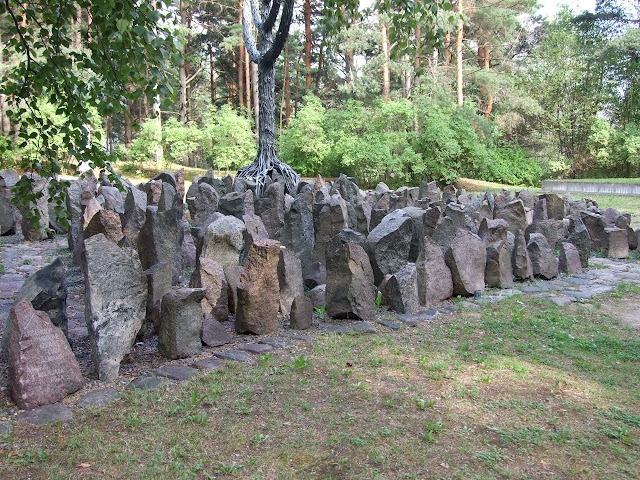 The Rumbula memorial consists of a small field of stones set up as a symbolic Jewish cemetery – some of the stones have the names of people and families known to have been killed at Rumbula, while others are blank. Around this memorial are areas of the mass graves, each with a big stone set up on it. The Nazis originally buried the bodies in several big mass graves, but in 1943 they had Jewish men dig up the bodies, burn them, and then bury the bones and ashes.
 Menorah in Rumbula memorial, surrounded by stones.
 Names of those known to be killed at Rumbula, engraved on one of the stones.
 More names.
 One of the mass graves at Rumbula, surmounted by a stone.
After we visited the memorial at Rumbula, Ieva took me to a small memorial statue set up at the site of the Riga Ghetto, and then to the one surviving synagogue, in the Riga Old Town. It survived because it was built too close to other buildings that would also have burned.
The next day, we drove out to Liepaja and saw several sites there, including the memorial at the Skede dunes, another site in the city where Jews were killed (there is a Soviet-era memorial there), a memorial set up at the Jewish cemetery to the approximately 6,400 Liepaja Jews who were killed, and the likely site of the house on Barinu iela that Mordechai Falkon and his wife lived in before the Nazi invasion.
My next post will be about the day in Liepaja.
I hired a guide to take me around Riga (on Wednesday) and to Liepaja (on Thursday), and also a car with driver and then a second guide in Liepaja (who did not speak English, so the first guide translated what she said). I found the guide through a man named Dr. Edward Anders, who grew up in Liepaja and was saved because he posed as a half-Jew. He has been instrumental in gathering records of what happened to the Jews of Liepaja during the Holocaust. (See here for his site on the Jews of Liepaja). Dr. Anders recommended a guide named Ieva Gundare, who is a historian who works for the Occupation Museum in Riga (it documents both the Nazi and Soviet occupations of Latvia).
I got into Riga with enough time to check in to the hotel and take a shower before Ieva arrived with the car and driver and we started our tour around Riga.
We first went to the Jewish Museum, which traces Jewish history in Latvia since about the 16th century, when Jews first settled in Latvia, up until the Nazi period, when most of the Jews of Latvia were murdered. There was some information about Liepaja, including about Jewish schools, sports groups, and the like. There was a Jewish community in Liepaja of between 6,000 and 7,000 before the war, and a much bigger one in Riga, the capital of Latvia. I met the director of the museum, Margers Vestermanis, whom my guide knew.
After going quickly through the museum, Ieva brought me to several more Jewish sites in Riga. When the Nazis invaded the Soviet Union on June 22, 1941, the Baltic states (Lithuania, Latvia, and Estonia) were among the first places they conquered. When they entered Riga, they destroyed all but one of the synagogues. We went to the ruins of the Choral synagogue, which has never been rebuilt. It was destroyed by the Nazis on July 4, 1941, very shortly after the Nazi invasion of the Soviet Union (June 22, 1941). The site has been turned into a memorial.

Our next stop was the memorial for the Jews who were killed at the Rumbula Forest, which in 1941 was outside Riga but is now inside the city. The Jews in the Riga Ghetto were forced to walk about 10 kilometers along the railroad lines until they reached the spot. About 25,000 were killed at the end of November/beginning of December 1941. A memorial has been built in the last few years.
One thing that I noticed and that the guide talked about was that during the years of Soviet occupation, when Latvia was part of the Soviet Union (1944-1991) the Soviets built monuments at various places where there had been Nazi massacres, but never specified that Jews were the victims (or were among the victims). The plaques simply talked about "victims of fascism," without being any more specific. The memorials that have been built since 1991 specifically discuss the Jewish victims.

In Latvian and English the plaque says:
Here in the forest of Rumbula, on November 30 and December 8 of 1941 the Nazis and their local collaborators shot dead more than 25,000 Jews, the prisoners of the Riga Ghetto, children, women, old people, as well as around 1,000 Jews deported from Germany. In the summer of 1944 hundreds of Jewish men from the concentration camp Riga-Kaiserwald were killed here.This plaque and the rest of the memorial were put into place in 2002.
What follows is the original plaque, set up during the Soviet era. It says “to the victims of fascism,” in Russian, Latvian, and Yiddish. Notice the hammer and sickle symbol. The inset plaque was inserted later, and reads, in Latvian and English: “This monument was erected in 1964 under the Soviet totalitarian regime by activists of the Riga’s Jewish community. It was the only Jewish memorial to victims of Nazi terror in the territory of the USSR.” Edward Anders refers to this as “Soviet Holocaust Denial.” Ieva told me that when she was growing up in Sovietized Latvia, she did not learn about the Holocaust in school – only in 1988 did she first learn about it (this was during the era of Glasnost in the Soviet Union when Gorbachev was the Soviet leader).

Andrew Ezergailis, a retired Ithaca College professor of history, who is from Latvia, wrote a history of the Holocaust in Latvia. In his chapter on Rumbula he writes:
Under the second Soviet domination of Latvia, Jewish culture was suppressed. Rumbula was not an event that the Soviets wanted to commemorate. Up to 1960, the Rumbula grounds were completely neglected and overgrown. Only in 1961 did young Jews of Rîga begin a search for the location of Rumbula. They found burned bones and other remains from the massacre. The grounds were in an especially disorderly shape because in 1944 the Nazis had partly disinterred the victims to burn them.
Rumbula galvanized the young Jews of Rîga, and in spite of official warnings it became their weekly gathering place. To divert attention from Rumbula, communist officials in 1962 organized a memorial meeting of Nazi victims at Bi˚ernieki. At the official meeting, the speeches were only about “Nazi victims;” Jews were not mentioned. Instead of quieting the movement, this slap at the memory of Jewish victims spurred the activities at Rumbula. In 1963 as many as 500 young Jews worked with shovels, pails, and wheelbarrows weekly to cleaned up Rumbula grounds. Today the burial grounds have the look of a small shady park within a forest of gnarly pine trees, with neat paths and raised mounds indicating the original pits. At the entrance to the grounds stands a modest slab with a hammer and sickle in the upper right-hand corner, inscribed in Latvian, Russian, and Yiddish: “To the Victims of Fascism, 1941-1944.” Among Rîga Jews, this monument is known as the “Aryan compromise.”


After we visited the memorial at Rumbula, Ieva took me to a small memorial statue set up at the site of the Riga Ghetto, and then to the one surviving synagogue, in the Riga Old Town. It survived because it was built too close to other buildings that would also have burned.
The next day, we drove out to Liepaja and saw several sites there, including the memorial at the Skede dunes, another site in the city where Jews were killed (there is a Soviet-era memorial there), a memorial set up at the Jewish cemetery to the approximately 6,400 Liepaja Jews who were killed, and the likely site of the house on Barinu iela that Mordechai Falkon and his wife lived in before the Nazi invasion.
My next post will be about the day in Liepaja.
Monday, April 12, 2010
"Among the Righteous" updated
I just finished watching "Among the Righteous" - it's a very interesting film, not only telling the stories of some Arabs who saved Jews in North Africa, but also asking the question of why this has not been researched and remembered. These are my notes on the film:
Among the Righteous
More than one hundred concentration camps were set up in North Africa, by the Vichy French, the Nazis, and the Italians. A camp in Libya named Giado was where the most Jews died of all of the camps. An interesting point made by Satloff is that even though knowledge of these camps had been forgotten for a long time, the movie Casablanca (made during the war) mentions concentration camps at a couple of points, so their existence was certainly known at the time.
One example of a righteous person whom Satloff found was an Arab nobleman named Ali Sikkat, in Tunisia. During fighting in 1943, sixty Jews were being kept in a labor camp fled the camp in the middle of a battle between the Allies and the Axis. Their lives were saved by Ali Sikkat, whose story was published already fifty years ago.
Satloff said that his search for a righteous Arab was politically loaded: why don’t we know these stories? Arabs don’t want to be found – it became toxic in many Arab countries to let it be known that you’d helped Jews. The problem is that Arab sympathy for the Palestinian people has prevented these stories from being unearthed and told, in order not to give support to Israel.
Historically speaking, Jews in Muslim lands lived as second class citizens (admittedly, usually better than the situation of Jews living in Christian countries). Jews were under legal prescriptions (as dhimmis who had to pay the jizya to gain legal protection), and from time to time there was violence against them. In the 1930s, the Jews of North Africa faced a new threat – fascism and antisemitism.
The only Holocaust memorial monument in all of North Africa commemorates a group of Tunisian Jews who were deported and killed in Europe – Joseph, Gilbert, Jean Scemla. Gilbert went to the Ecole Polytechnique (highest French university), and fought with the French against the Nazis in 1940.
France’s Vichy government was almost as antisemitic as the German government. After the fall of France, Gilbert rejoined his family in Tunis, since he was no longer at home in France. But North Africa was becoming less hospitable to Jews – the film shows images of Petain, and the fascist salute.
The strict quotas of France’s antisemitic laws were imposed in French North Africa. Jewish businesses were confiscated, Jews were barred from the professions, Jewish children were kicked out of schools, and Jews were stripped of their citizenship.
The Vichy government established harsh internment camps in Algeria and Morocco, in the Sahara. The
Jewish prisoners were mostly from central Europe, people who had fled to North Africa from the Nazis in Europe. Satloff relays testimonies from Polish Jewish survivors who were liberated by the British. One of the tasks laid upon the prisoners was to build the trans-Sahara railway. A couple of the camps in Morocco were in Bergen and Tendrara, where people died of starvation, insects, exposure, and illness.
In beginning of 1942, Rommel (general of the Afrika Korps) entered Egypt. Hitler ordered him to hold North Africa. Operation Torch, the beginning of the Allied counteroffensive against the Nazis, landed American and British troops in North Africa. The video shows the war cemetery in Tunis, with the graves of 6,000 American troops (I never knew this).
German troops invaded Tunisia - it was the only Arab country to be occupied by the Nazis. Once the Germans entered Tunisia, they began the usual routine of persecuting the Jews. The SS commander in Tunis was Walter Rauf, the Nazi commander who had been involved in organizing the mobile gas killing vans in eastern Europe. In December, 1942, Rauf rounded up Jews in Tunis. Jewish laborers were forced to wear the yellow star.
How did Arabs react to the persecution of their Jewish neighbors? Most were bystanders, a few made their hatred heard – “you Jews, you Yids, will all have your throats cut.” Some Arabs enlisted in the German army, others volunteered to guard the camps, and a few rescued Jews from Nazi persecution.
Joseph Naccache said that his neighbors had shielded him. Satloff found his house and the hammam (bathhouse) where he had been protected. Why did they protect the Jews? Because Jews and Muslims were like brothers (speaking to the son of the man who protected Naccacche).
Satloff showed the marble mausoleum of King Mohammed V of Morocco, who was king during WWII. He defied the Vichy authorities and said that in his kingdom there were no Jews or Muslims – only Moroccan citizens. The Vichy authorities wanted Moroccan Jews to wear the yellow star, but the king refused, saying that he too would wear the yellow star. In Algeria there were Muslim religious objections to Vichy laws against the Jews. An announcement was made in the mosques forbidding any Muslim believer from serving as a custodian of confiscated Jewish property. The newly crowned king of Tunisia under Nazi rule told the Jews he thought of them as part of his family.
To return to the Scemla family. They moved to the seaside town of Hammamat. Gilbert and Jean decided to fight with the French resistance. They then tried to escape, with the help of Hassan Vergany, who was a friend of the family. Vergany turned them into the Germans, and they were arrested outside of the German headquarters of Rommel himself. Joseph Scemla and his two sons were sent to the old Turkish prison in Tunis. In April 1943 they were sent to Dachau in Germany with 50 other prisoners.
It was a year before the Germans decided on their fate.
Satloff then recounted the story of Khaled Abdul Wahad, who owned a farm in Tunisia. Annie Bouqris told of this Arab landowner who saved her life and the life of her family. His daughter is still alive, and she said that at that time she knew that there were some Jewish families on the farm.
Edmee Masliah was told that her family’s home was being taken by the Nazis. Her family took refuge in an abandoned olive oil factory along with other Jewish families. Khaled wined and dined the German soldiers and learned that one of them had his eye on a Jewish girl. Khaled went to the oil press factory and told the Jews they had to leave immediately, and he led them to his farm, where they stayed in the stables. This should have been a perfect hiding place for the Jews, but soon after they arrived, a German regiment pitched its tents right on the edge of his property. Khaled told them not to wear their Jewish stars, so no one would know they were Jewish. One night when the men were away doing forced labor, the women and children almost came to grief. Khaled was still entertaining Germans to keep informed; a drunken German wandered off into the Bouqris family’s bedroom and threatened to rape one of the girls. He told them he was going to kill them that night. At that moment Khaled showed up and led away the German from the Jews.
That spring the German army was caught in a pincer between the British and American armies. Hundreds of thousands of German soldiers were captured. The ordeal of North African Jews was almost over. Satloff showed a film clip of Jews in Tunisia taking off the yellow stars.
To return to Joseph Scemla and his sons: they were transferred to the prison at Halle, Germany, and all were condemned to death. (Vergany was also condemned to 14 years in jail when the Free French took over Tunisia after the defeat of the Germans in 1943).
When Satloff lectures in Arab countries about the Holocaust, some Arabs yell at him, and say why are we talking about the Holocaust of 60 years ago instead of the Holocaust of the Palestinian Arabs today (he shows a clip of man who left his lecture yelling at him). A Palestinian Arab woman says we can now make a choice for peace, but many Arabs don’t want to recognize the Holocaust out of the fear that it means the acceptance of Israel.
In Israel – Satloff asks why haven’t we looked for Arab rescuers? He presents more stories from Tunisian survivors – about how they were saved from Germans by Arab neighbors. Satloff is trying to get Khaled Abdul Wahad recognized as one of the Righteous – but Yad Vashem has refused, out of doubt that he risked his life for Jews (which is required to declare someone a Righteous Gentile).
Among the Righteous
More than one hundred concentration camps were set up in North Africa, by the Vichy French, the Nazis, and the Italians. A camp in Libya named Giado was where the most Jews died of all of the camps. An interesting point made by Satloff is that even though knowledge of these camps had been forgotten for a long time, the movie Casablanca (made during the war) mentions concentration camps at a couple of points, so their existence was certainly known at the time.
One example of a righteous person whom Satloff found was an Arab nobleman named Ali Sikkat, in Tunisia. During fighting in 1943, sixty Jews were being kept in a labor camp fled the camp in the middle of a battle between the Allies and the Axis. Their lives were saved by Ali Sikkat, whose story was published already fifty years ago.
Satloff said that his search for a righteous Arab was politically loaded: why don’t we know these stories? Arabs don’t want to be found – it became toxic in many Arab countries to let it be known that you’d helped Jews. The problem is that Arab sympathy for the Palestinian people has prevented these stories from being unearthed and told, in order not to give support to Israel.
Historically speaking, Jews in Muslim lands lived as second class citizens (admittedly, usually better than the situation of Jews living in Christian countries). Jews were under legal prescriptions (as dhimmis who had to pay the jizya to gain legal protection), and from time to time there was violence against them. In the 1930s, the Jews of North Africa faced a new threat – fascism and antisemitism.
The only Holocaust memorial monument in all of North Africa commemorates a group of Tunisian Jews who were deported and killed in Europe – Joseph, Gilbert, Jean Scemla. Gilbert went to the Ecole Polytechnique (highest French university), and fought with the French against the Nazis in 1940.
France’s Vichy government was almost as antisemitic as the German government. After the fall of France, Gilbert rejoined his family in Tunis, since he was no longer at home in France. But North Africa was becoming less hospitable to Jews – the film shows images of Petain, and the fascist salute.
The strict quotas of France’s antisemitic laws were imposed in French North Africa. Jewish businesses were confiscated, Jews were barred from the professions, Jewish children were kicked out of schools, and Jews were stripped of their citizenship.
The Vichy government established harsh internment camps in Algeria and Morocco, in the Sahara. The
Jewish prisoners were mostly from central Europe, people who had fled to North Africa from the Nazis in Europe. Satloff relays testimonies from Polish Jewish survivors who were liberated by the British. One of the tasks laid upon the prisoners was to build the trans-Sahara railway. A couple of the camps in Morocco were in Bergen and Tendrara, where people died of starvation, insects, exposure, and illness.
In beginning of 1942, Rommel (general of the Afrika Korps) entered Egypt. Hitler ordered him to hold North Africa. Operation Torch, the beginning of the Allied counteroffensive against the Nazis, landed American and British troops in North Africa. The video shows the war cemetery in Tunis, with the graves of 6,000 American troops (I never knew this).
German troops invaded Tunisia - it was the only Arab country to be occupied by the Nazis. Once the Germans entered Tunisia, they began the usual routine of persecuting the Jews. The SS commander in Tunis was Walter Rauf, the Nazi commander who had been involved in organizing the mobile gas killing vans in eastern Europe. In December, 1942, Rauf rounded up Jews in Tunis. Jewish laborers were forced to wear the yellow star.
How did Arabs react to the persecution of their Jewish neighbors? Most were bystanders, a few made their hatred heard – “you Jews, you Yids, will all have your throats cut.” Some Arabs enlisted in the German army, others volunteered to guard the camps, and a few rescued Jews from Nazi persecution.
Joseph Naccache said that his neighbors had shielded him. Satloff found his house and the hammam (bathhouse) where he had been protected. Why did they protect the Jews? Because Jews and Muslims were like brothers (speaking to the son of the man who protected Naccacche).
Satloff showed the marble mausoleum of King Mohammed V of Morocco, who was king during WWII. He defied the Vichy authorities and said that in his kingdom there were no Jews or Muslims – only Moroccan citizens. The Vichy authorities wanted Moroccan Jews to wear the yellow star, but the king refused, saying that he too would wear the yellow star. In Algeria there were Muslim religious objections to Vichy laws against the Jews. An announcement was made in the mosques forbidding any Muslim believer from serving as a custodian of confiscated Jewish property. The newly crowned king of Tunisia under Nazi rule told the Jews he thought of them as part of his family.
To return to the Scemla family. They moved to the seaside town of Hammamat. Gilbert and Jean decided to fight with the French resistance. They then tried to escape, with the help of Hassan Vergany, who was a friend of the family. Vergany turned them into the Germans, and they were arrested outside of the German headquarters of Rommel himself. Joseph Scemla and his two sons were sent to the old Turkish prison in Tunis. In April 1943 they were sent to Dachau in Germany with 50 other prisoners.
It was a year before the Germans decided on their fate.
Satloff then recounted the story of Khaled Abdul Wahad, who owned a farm in Tunisia. Annie Bouqris told of this Arab landowner who saved her life and the life of her family. His daughter is still alive, and she said that at that time she knew that there were some Jewish families on the farm.
Edmee Masliah was told that her family’s home was being taken by the Nazis. Her family took refuge in an abandoned olive oil factory along with other Jewish families. Khaled wined and dined the German soldiers and learned that one of them had his eye on a Jewish girl. Khaled went to the oil press factory and told the Jews they had to leave immediately, and he led them to his farm, where they stayed in the stables. This should have been a perfect hiding place for the Jews, but soon after they arrived, a German regiment pitched its tents right on the edge of his property. Khaled told them not to wear their Jewish stars, so no one would know they were Jewish. One night when the men were away doing forced labor, the women and children almost came to grief. Khaled was still entertaining Germans to keep informed; a drunken German wandered off into the Bouqris family’s bedroom and threatened to rape one of the girls. He told them he was going to kill them that night. At that moment Khaled showed up and led away the German from the Jews.
That spring the German army was caught in a pincer between the British and American armies. Hundreds of thousands of German soldiers were captured. The ordeal of North African Jews was almost over. Satloff showed a film clip of Jews in Tunisia taking off the yellow stars.
To return to Joseph Scemla and his sons: they were transferred to the prison at Halle, Germany, and all were condemned to death. (Vergany was also condemned to 14 years in jail when the Free French took over Tunisia after the defeat of the Germans in 1943).
When Satloff lectures in Arab countries about the Holocaust, some Arabs yell at him, and say why are we talking about the Holocaust of 60 years ago instead of the Holocaust of the Palestinian Arabs today (he shows a clip of man who left his lecture yelling at him). A Palestinian Arab woman says we can now make a choice for peace, but many Arabs don’t want to recognize the Holocaust out of the fear that it means the acceptance of Israel.
In Israel – Satloff asks why haven’t we looked for Arab rescuers? He presents more stories from Tunisian survivors – about how they were saved from Germans by Arab neighbors. Satloff is trying to get Khaled Abdul Wahad recognized as one of the Righteous – but Yad Vashem has refused, out of doubt that he risked his life for Jews (which is required to declare someone a Righteous Gentile).
Yom HaShoah

To quote from the Temple website:
Inmates of concentration camps made thousands of clandestine drawings and paintings. In fact some 5,000 drawings and paintings survived the war – each one revealing a human dimension – providing us with a rare glimpse of the daily existence in the camps.... It reveals the little-known work of artists who left expressive evidence of what they witnessed. Mr. Dennis states, "We cannot understand it and appreciate it say in the same way we might a Rembrandt…. Victims of the Holocaust risked their lives to make art so that others may understand what they had to endure. There are very few situations where so much art can offer this unique perspective on history. It should always be a priority to study how others have suffered and survived, sacrificed and endured, and left their creative mark on history." Marc Dennis is an award winning professor and nationally recognized artist and Holocaust researcher. He teaches drawing, painting and digital imaging, as well as a course on the history of the Holocaust with a specific focus on the art of Europe from 1933-1945.In the evening, I went to a staged reading of the play "Kindertransport," written by Diane Samuels. It was performed by On the Verge, a joint effort by the English and Theater Departments at Ithaca College, which puts on staged readings once or twice a year. The New York Times review of the performance in New York City in 1994 said of the play:
Yet another investigation of the Holocaust and its continuing reverberations, "Kindertransport," which opened last night, approaches the subject from the unusual perspective of a child who escaped the immediate horrors but paid a heavy price anyway. Kindertransport was the plan formed in 1938, in reaction to Kristallnacht and the rising Nazi threat, to evacuate children from Germany and Eastern Europe. Before World War II erupted, nearly 10,000 youngsters, most of them Jewish, had made it to England.The performance was excellent, I thought - even though the actors had only rehearsed twice, they did very well, and I found it moving.
Ms. Samuels, an Englishwoman, has set her play in the attic of a suburban London house in the 1980's. Evelyn (Dana Ivey), a brusque middle-aged housewife, and her daughter, Faith (Mary Mara), are sorting through the cardboard boxes and steamer trunks. Theirs is a touchy relationship, although we're not to find out why for a while, and the air is charged with animosity.
At the same time, in a series of flashbacks, we follow the progress of Eva, a frightened 9-year-old Jewish girl (Alanna Ubach). Tagged like a piece of luggage, she leaves her mother in Hamburg and travels to England, where the well-meaning Lil (Patricia Kilgarriff) takes over her upbringing. Little by little, the distraught child grows into a reserved young woman. Her accent fades. And so, presumably, do the old traumas.
When I got home from the performance, I watched the latest staging of the life of Anne Frank, produced in Britain and broadcast on Masterpiece Theater (PBS). The show had the same effect that the story always does on me - it makes the life of Anne Frank vivid and real, and then at the end we discover what happened to her - she died in Bergen Belsen only two months before the war ended.
Tonight I'll be watching another PBS production - Among the Righteous: Lost Stories from the Holocaust in Arab Lands. From the website:
Did any Arabs save Jews during the Holocaust? That's the question author Robert Satloff had in mind when he set out to discover the lost, true stories of survival, courage and betrayal in Arab lands during World War II. The history of the Holocaust in Europe is well-documented, but the history of what happened to the Jewish people of North Africa has been mostly forgotten, even in the very towns and cities where it occurred. The truth is remarkable: not only did Jews in Arab lands suffer many of the same elements of persecution as Jews in Europe -- arrests, deportations, confiscations and forced labor -- but there were also hopeful stories of "righteous" Arabs reaching out to protect them.I'm glad that this film has been made - most American Jews (or for that matter, American non-Jews) don't know anything about what happened to the Jews in North Africa during WWII. I think it's important for people to know this history, so that they don't imagine the Holocaust was simply a European story. If the Germans had succeeded in holding North Africa and then conquering Palestine, the Jews there would also have been killed like those in Europe. (The Nazi advance towards Egypt was halted at the first battle of El Alamein in July, 1942; the second battle of El Alamein in October-November 1942 was the first significant Allied victory against Axis forces and the beginning of the retaking of North Africa). We can see from how thoroughly the Nazis killed the Sephardic Jews of Greece, the Greek islands, and the Balkans, how they would also have killed the Sephardic and Middle Eastern Jews.
Sunday, April 4, 2010
New York Times, June 10, 1945 - Estimate of number of Jews murdered
The New York Times reported on June 10, 1945, about the number of Jews killed by the Nazis. Since this is such an early report, some of the information in this article was later known to be inaccurate, but this is the first version of what happened to the Jews of Europe under the Nazis.
80% OF REICH JEWS MURDERED BY NAZIS
All Those Left in Europe were Marked for Death by 1946, AMG [Allied Military Government] Investigation Shows
Only 150,000 Survived
Extermination Plan Revealed - Russians Estimate Several Million Died in East
FRANKFURT ON MAIN, Germany, June 8 (Delayed) (U.P.) - The Nazis exterminated at least 80 percent of Germany's Jews, and every remaining Jew in occupied Europe was marked for murder before the summer of 1946, it was revealed today.
It now is possible to give the full story of the Nazis' plan to wipe out all of Europe's 12,000,000 Jews. Allied Military Government authorities, after a painstaking study, reported that a majority of the Jews in Germany met death between 1939 and 1942. Russian officials estimate several million Jews were exterminated at concentration camps in Poland and White Russia during the German occupation.
On the basis of this information, it is believed that less than 20 percent, or about 150,000 of the original group in the Reich, survived the reign of terror. These survivors are being returned to their homes as soon as possible. Germans who dispossessed them are being ousted. In most cases, this is done without serious friction, despite the years of intensive anti-Semitic propaganda.
Synagogues Reopened
In several cities, including Aachen, Cologne, and Frankfort on Main, synagogues have been reopened and Jewish services conducted for the first time since November, 1938.
Some homeless Jews are cared for by the United Nations Relief and Rehabilitation Administration. Included are 500 Jewish children, mostly between the ages of 15 and 17, but some as young as 10. They were rescued from the Buchenwald camp and now are at Thionville in Lorraine, in the French zone.
The Nazis' master plan was engineered by Dr. Alfred Rosenberg, reportedly an Allied prisoner. He was aided by Propaganda Minister Joseph Goebbels and Gestapo Chief Heinrich Himmler. The plan originally called for a "Jew-free Reich" by April 1, 1942, as a birthday present to Adolf Hitler, but it was slowed down by transportation difficulties.
Its first stage began after Poland fell in 1939. Jews were to be used as slave laborers in war factories built in that country. They were to die gradually of starvation, disease and cold. The first contingent of Jews from Germany was rounded up in Stettin, Cologne and Frankfort on Main - about 50,000 in all. They were shipped to Lublin in October and November, 1939. Transportation trouble set in and only a few thousand were deported eastward during the next two years.
Few left unmolested
The drive began in earnest in September, 1941. It continued full blast until scarcely a Jew was left unmolested in Germany or any occupied country. In Berlin the Nazis began in 1941 to deport about 20,000 persons eastward each month. They were stripped, searched, robbed and then packed in trucks and rail cars. Some worked in airplane and textile plants. Others were thrown into ghettos. Thousands went straight to extermination camps.
Relatives and friends in the Reich seldom if ever heard of them again. More than once the trains were stopped and all Jews were ordered out and massacred.
The third stage of the program was launched early in 1943, well after the original deadline for the whole plan. The Nazis rounded up and deported Jews from France, Belgium, the Netherlands, Hungary, Romania, and Yugoslavia. Some were sent to Poland and others to concentration camps in Germany. Tens of thousands were killed monthly in these camps. The Nazis in 1943 began emptying the ghettos of Warsaw, Riga, Lublin and other large cities, and started systematic extermination by gas.
UNRRA officials expressed the belief that if the war had lasted another year, the Nazis might have come very close to their objective of wiping out all Jews in Europe.
Starvation Still Reported
The Vaad Hatzala Emergency Committee, with headquarters at 32 Nassau Street, disclosed yesterday that Jewish survivors of Nazi horror camps, freed but temporarily residing there until they can be repatriated or emigrated, "are living under conditions bordering upon starvation." The committee said that it had received word of the plight of the Jewish survivors from Isaac Sternbuch, its representative in Switzerland, who made a cabled plea for relief funds.
Mr. Sternbuch said all available food stocks purchased abroad with Vaad Hatzala funds already had been dispatched on International Red Cross trucks to concentration camps at Landsberg, Dachau, Mauthausen and Theresienstadt.
Thursday, December 31, 2009
Gaza "Freedom" Marchers and Alice Walker
More on the Freedom Marchers themselves (clever title, that - reminding us of the people who went to the southern U.S. to work for equal rights for African Americans - which did not, of course, entail working with terrorist groups!), from the Egyptian authorities, who seem to regard them as a major nuisance.
She also seems to consider Israel unredeemable, despite all of her talk about reconciliation:
It also seems that she is taking a kind of unholy glee in the thought that Jews will once again be a minority in Palestine, as if this is really the correct state of affairs. Jews should know their place, which is not to be able to wield power by controlling their own independent state.
And to think I once admired Alice Walker!
The Egyptian foreign minister, Ahmed Aboul Gheit, expressed frustration at the activists who came to Cairo despite the warning that the border was closed. “Those who tried to conspire against us, and they are more than a thousand, we will leave them in the street,” he said.One of the Code Pinkers, Alice Walker, seems to have a very peculiar idea of how the Israeli-Palestinian conflict began. She writes in her blog:
And so I have been, once again, struggling to speak about an atrocity: This time in Gaza, this time against the Palestinian people. Like most people on the planet I have been aware of the Palestinian–Israeli conflict almost my whole life. I was four years old in 1948 when, after being subjected to unspeakable cruelty by the Germans, after a “holocaust” so many future disasters would resemble, thousands of European Jews were resettled in Palestine. They settled in a land that belonged to people already living there, which did not seem to bother the British who, as in India, had occupied Palestine and then, on leaving it, helped put in place a partitioning of the land they thought would work fine for the people, strangers, Palestinians and European Jews, now forced to live together.Why does she put the word Holocaust in quotes? Wasn't it one? And is the only important thing about the Holocaust that it led to Holocaust survivors settling in Palestine? Like many other anti-Israel activists, she has the mistaken notion that the Jews who went to Palestine were only from Europe. What of the hundreds of thousands of Jews from Arab and Muslim who emigrated to Israel? Her statement about the role of the British is also entirely incorrect. The British were not in favor of the UN partition plan - they abstained during the vote on November 29, 1947. They did nothing to implement it once the UN approved it.
She also seems to consider Israel unredeemable, despite all of her talk about reconciliation:
There are differing opinions about this, of course, but my belief is that when a country primarily instills fear in the minds and hearts of the people of the world, it is no longer useful in joining the dialogue we need for saving the planet.She also thinks that the people of Gaza have been subjected to genocide:
This is a chilling use of power, supported by the United States of America, no small foe, if one stands up to it. No wonder that most people prefer to look the other way during this genocide, hoping their disagreement with Israeli policies will not be noted.She argues for a one-state solution without any concern at all for the lives of Israeli Jews:
What is to be done? Our revered Tolstoy asked this question, speaking also of War and Peace. I believe there must be a one state solution. Palestinians and Jews, who have lived together in peace in the past, must work together to make this a reality once again. This land (so soaked in Jewish and Palestinian blood, and with America’s taxpayer dollars wasted on violence the majority of us would never, if we knew, support) must become, like South Africa, the secure and peaceful home of everyone who lives there. This will require that Palestinians, like Jews, have the right of return to their homes and their lands. Which will mean what Israelis most fear: Jews will be outnumbered and, instead of a Jewish state, there will be a Jewish, Muslim, Christian country, which is how Palestine functioned before the Europeans arrived. What is so awful about that?Does she know anything about Ottoman rule of Palestine? It was rule by a Muslim empire which favored Muslims over Christians or Jews. In saying this I'm not arguing that it was an evil empire - but that its rulers had their own interests and beliefs, among them that Islam was superior to other religions and that the "peoples of the book" should be tolerated but treated as second-class citizens. The Ottoman Empire began to treat its religious minorities better throughout the 19th century, with the reform movement known as the Tanzimat, but it certainly was not a model of religious equality. And this is even without considering the Armenian Genocide, which was wrought by the Ottoman government in its dying days during WWI. Walker's idea of Palestine before British rule seems to be governed by a gauzy nostalgia for an imagined past. Perhaps she should consult a variety of histories of Palestine, not simply those written by Ali Abunimah and others who argue for the one-state solution.
It also seems that she is taking a kind of unholy glee in the thought that Jews will once again be a minority in Palestine, as if this is really the correct state of affairs. Jews should know their place, which is not to be able to wield power by controlling their own independent state.
And to think I once admired Alice Walker!
Subscribe to:
Posts (Atom)